COLLABORATIVE JOURNALISM
U.S. DEMOCRACY DAY
Black and white photograph of protesters
Special Report

Democracy Day 2025: How journalists respond to democracy under threat.

In the U.S. and abroad, a free, independent press is often understood as a crucial pillar of a healthy, functioning democracy. But what does this actually look like, in practice?

Executive Summary

Ideally, journalists keep the public informed and hold elected officials accountable, allowing citizens to participate in a government that represents them. How do journalists know if they are doing a good job?


Most American journalism organizations are increasingly strapped for resources and unable to perform critical functions to inform the public and hold elected officials accountable. At the same time, the U.S. president has attacked elections, government agencies, the existence of a free independent press and more core democratic institutions. In short: the pillars of U.S. democracy are facing serious, high-level threats with not enough journalists to support them.


Several initiatives have emerged to bolster journalism in service of democracy, including U.S. Democracy Day, a collaborative project of the Center for Cooperative Media at Montclair State University's College of Communication and Media in New Jersey.


U.S. Democracy Day is currently supported by funding from the John S. and James L. Knight Foundation.


In its fourth year of existence, U.S. Democracy Day has worked with hundreds of local newsrooms across all 50 states to publish more than 700 pieces of pro-democracy journalism.

Four key takeaways

01

The core focus is local.

A strong and growing coalition of local news organizations are reporting on issues of local governance with a focus on community engagement. National democratic threats have inspired journalists and communities to better engage with the most basic elements of democracy on the local level, from public government meetings to local elections.

02

Elections drive engagement.

Audience interest is highest around voting and elections, and communities want to be engaged and participate in the reporting process. Community engagement methods like the citizens agenda involve and center voters in elections reporting, and can continue to drive engagement in follow-up civic coverage after elections.

03

More funding is necessary.

The most requested form of support is funding for staff and resources, including software and data tools. While obvious to those working in journalism, most Americans are not aware that local news organizations need more money to better report on local government, elections, and voting.

04

Be specific with democracy language.

Journalists and communities have come to view the term “democracy” as both vague and polarizing. It’s more effective to use specific language about the levers of democracy like elections, voting, and government when conducting reporting or communicating the value of local news to audiences.

For their help in making Democracy Day possible and compiling this report, many thanks to Rachel Glickhouse, Bridget Thoreson, Jennifer Brandel, Jaisal Noor, Michelle Faust-Raghavan, Will Fischer, Stefanie Murray, Joe Amditis, Ming-Jing Qin, and Beatrice Forman.


Background: Democracy Day, 2022-2024

The U.S. Democracy Day collaborative emerged in 2022 with one guiding focus — encouraging more pro-democracy journalism. A group of local news leaders were concerned about growing authoritarian movements and frustrated over media coverage that largely framed politics as "horse race" coverage focused on candidates, not voters. Specifically, the group wanted to see more community-centered coverage of democratic issues including elections, voter rights, local government, and corruption.


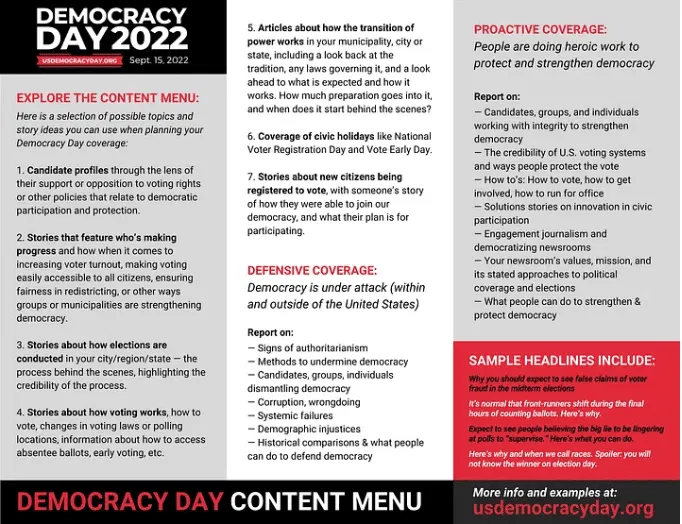
The goal was to encourage as many newsrooms as possible to join the collaborative and commit to publishing at least one piece of pro-democracy journalism on September 15, known as the International Day of Democracy. Nearly 200 newsrooms across 41 states participated in 2022, taking inspiration from a content menu of democracy reporting examples. In total, the collaborative produced about 250 stories.


Democracy Day content menu
The first iteration of Democracy Day's content menu in 2022.

The John S. and James L. Knight Foundation made the first year of Democracy Day possible with a $20,000 grant, and the collaborative secured further funding in 2023, receiving a $125,000 grant from Democracy Fund. This allowed the implementation of a dedicated staff, advisory board, stipends, and more training and webinars — as well as publishing an impact report detailing the group's progress and efforts. For 2024, Democracy Day received a Hearken grant of $75,000, and additional support from the Knight Foundation, spread out with $32,760 earmarked for 2024 and $50,000 for 2025.


This continued funding helped the collaborative grow to 241 news organizations across 50 states and Puerto Rico, publishing more than 268 stories in 2024. Democracy Day was less than two months before a contentious presidential election in which threats to democracy were a major theme, and the group was able to provide more direct funding to local news organizations than ever before:


2024 milestones:

  • Stipends: 17 news organizations received $34,000 total in funding to support democracy-focused reporting and engagement projects.
  • Support: 66 news organizations received $75 gift cards to help newsrooms buy food for their journalists.
  • Fundraising: 47 news organizations participated in a pilot NewsMatch fundraising campaign to raise more than $57,000 for local news.

Reflection: A new approach for Democracy Day 2025

But the outcome of the 2024 presidential election raised concerns and further questions. The very term "democracy" became overtly politicized and partisan, and many of the democratic institutions and freedoms taken for granted in the U.S. suddenly came into question. In July 2025, a NPR/Marist/PBS poll found that more than 75% of Americans believe democracy is under serious threat. The group had to take a step back and ask: What is democracy reporting in such an environment, anyhow?


Democracy Day 2025 was all about reflection. With support from the Knight Foundation, the group encouraged partners to mark the day on social media, gave out impact awards, and hosted its first live event with a panel discussion featuring democracy reporters in New York City. The main goal, however, was to hear from news organizations through a survey about how journalists and communities are thinking about democracy in a time when many of the country's democratic principles are being threatened.


The survey ran from July 30 to September 15, and 54 respondents answered the four main questions:


  • Journalism: What is your current approach to democracy reporting? Has this changed at all in the last year?
  • Community: What issues have been resonating most with your audience and/or community in your civic coverage?
  • Support: What forms of support would be most helpful to strengthen your democracy reporting efforts?
  • What else: Is there anything else you think we should know about democracy reporting at your organization?

Respondents received a $20 gift card for answering all the questions. Most were prior Democracy Day participants, and nearly all were working journalists, with a small minority working at journalism-focused foundations, community groups, or university programs. The survey, along with additional research and interviews, revealed four major findings.

Finding 01 Survey data analysis

The core focus is local.

Despite national politics capturing so much attention, local governance is the core focus of the partners in the Democracy Day collaborative. Local news organizations are responding to national democratic threats by focusing on the building blocks of democracy at the local level — covering government meetings, producing civic guides, and diving into local elections — with a major emphasis on engaging their communities to learn more and get involved.


Sioux Falls Simplified, a local news organization in South Dakota, created a series of guides and civic explainers called Sioux Falls 101; the guidelines broke down complex local governance topics like the city budget. According to founder Megan Raposa, the coverage is meant to engage community members in the most basic but often overlooked elements of local governance, from school boards to county commissions. Raposa is hoping that by explaining these topics and covering meetings, Sioux Falls Simplified can increase civic health — a measure of how communities participate in democracy.


"We're hyperlocal, so we're very focused on how paying attention to democracy at its smallest iterations can make a big difference. As a result, we've increased our focus dramatically on local government, civic engagement, and promoting the overall civic health of Sioux Falls." — Megan Raposa

In Illinois, Cicero Independiente is also addressing civic participation with specific communities in mind. The bilingual news organization covers Cicero and Berwyn, neighboring towns outside Chicago that both have majority immigrant and Spanish-speaking populations. According to co-founder Irene Romulo, there is a long history of corruption and distrust between the local government and community, which Cicero Independiente looks to bridge in its coverage.


"For years, our town has operated with very little transparency resulting in a huge lack of trust towards our elected officials. Many of our readers believe that local officials are corrupt and that they do not hold the best interest of the people. Our reporting aims to shed light on our local government, make its processes accessible, and uplift monolingual Spanish-speakers who are traditionally excluded from many local decision-making spaces." — Irene Romulo

Back in 2022, Cicero Independiente hosted a nonpartisan workshop called How to Run for Elected Positions in Cicero and Berwyn. Romulo said three people who attended later credited the workshop and follow-up reporting with inspiring them to run for local board positions in 2025. While the newsroom did not show support for any candidate, it provided live election coverage for the first time ever, partnering with a local civil rights firm to become nonpartisan poll watchers and working with the County Clerk to make sure voter rights were protected.


Romulo said that Cicero Independiente also received numerous questions about the voting process on social media, answered them in real time, and received feedback from readers saying that this kind of coverage helped them feel like their votes mattered. This type of coverage came up frequently in the survey, and highlights an overarching theme of audience interest — voter engagement around elections.

Approach to reporting

Finding 02 Survey data analysis

Elections drive engagement.

When it comes to audience interest, elections and voting are the most resonant topics by a significant margin. This highlights a clear public demand for reporting around voting and elections, and communities want to be engaged and participate in this process.


Voter guides and election hubs are the most prominent pieces of journalism reported in the survey. Many news organizations used the citizens agenda method to shape their reporting, which centers voters in the production of election coverage. For example, The Colorado News Collaborative (COLab), which includes journalists from about 200 newsrooms across Colorado, launched a Voter Voices project ahead of the 2024 election — engaging more than 7,000 Coloradans with surveys asking about what community members wanted to hear from candidates ahead of local, statewide, and national elections.


According to executive director Laura Frank, more than 60 Colorado newsrooms in the collaborative used the community feedback to shape their coverage, and the model has had a major impact on how COLab conducts reporting.


"Newsrooms used surveys, events, and outreach to engage the public — and many reshaped their reporting based on what they heard. COLab now applies this approach to all major reporting collaborations, including our current collaborative project focused on immigration, a topic that emerged through Voter Voices as a top concern of Coloradans." — Laura Frank

In West Virginia, Mountain State Spotlight also employed a version of the citizens agenda to build out a to-do list for elected officials. According to audience manager Tyler Dedrick, the to-do list was a hit with readers and was cited by the League of Women Voters of West Virginia at in-person events and in their voting materials. Dedrick said the nonprofit newsroom also built out the most comprehensive election guide in the state using the Govpack tool, a WordPress plugin launched by Newspack that provides newsrooms with an easy, intuitive way to produce voter guides.


Many survey respondents cited resources and tools like software as a major part of their democracy reporting. Overall, it was no surprise that the third major theme — funding — was the most desired form of support. In many cases, survey respondents cited the need for more staff and capacity to do better reporting and community listening. But they also requested help in specialized areas like data and tools.

Community issues of interest

Finding 03 Survey data analysis

More funding is necessary.

The survey responses send an unambiguous message — the greatest challenge is a lack of resources. Funding is the most cited need and a direct means to increase capacity, hire reporters, and dedicate more time to in-depth coverage.


In Alaska, Mat-Su Sentinel is a nonprofit local newsroom covering the Matanuska-Susitna Valley, just north of Anchorage. The Sentinel was one of 17 organizations that received a $2,000 project stipend from the Democracy Day collaborative in 2024, and in the survey, founder Amy Bushatz noted how valuable the financial support was for purchasing software tools like ElectUp to create the region's first-ever voter guides.


In particular, Bushatz said they were able to build robust digital election guides with the ElectUp software tool, which would not have been possible without the provided funding. With support from the Tiny News Collective, Bushatz added that the Sentinel was able to again produce voter guides in 2025 with the same software tools, as well as host candidate forums and election events.


"Our democracy reporting centers around creating access to and information for voting. My audience is eager to encounter community connection events and opportunities for civic participation, and any coverage of these topics does much better than I expect." — Amy Bushatz

There is demonstrated audience interest and a clear need for consistent reporting on voting, elections, and local governance. But this work is reliant on funding. Almost every single respondent cited the need for funding, staff, and/or resources in response to the third survey question asking about forms of support. While the need for more funding is obvious to those working in journalism, research has shown that most Americans don't understand how strapped local news organizations are for resources.


Yet at the same time, large journalism funders are calling into question the language that local news organizations use regarding "democracy" when communicating the value of local news to audiences. This highlights the fourth major finding, presenting a major challenge to local news organizations in carefully choosing the language they use when appealing to different audiences and communities.

Support needed

Finding 04 Strategic analysis

Be specific with democracy language.

In October 2025, Press Forward, a national funding network working to strengthen local news, published research advising newsrooms to avoid phrases like "democracy" when communicating with audiences, citing the increasingly partisan nature of the word.


The Democracy Day collaborative found similar themes in the survey and through additional interviews. Kira Lerner is the democracy editor at The Guardian, where she leads a team of regional reporters focused on covering voting rights and threats to democracy around the U.S. Lerner said that it has been difficult to define exactly what democracy means in The Guardian's coverage, and that it's more helpful to talk about the specific impacts that policies have on people.


"We can look back at how the 2024 presidential election went, where Democrats talking about Trump being a threat to democracy did not resonate extremely well with most voters. It wasn't winning messaging. With that being said, when you get down to the nitty-gritty and talk about what's at stake, and how it's impacting people, that really resonates." — Kira Lerner

Jessica Huseman, the editorial director at VoteBeat, shared a similar sentiment. Huseman said that VoteBeat is solely focused on election administration and voting access in the U.S., which allows her newsroom to largely avoid the often vague framing of democracy language.


"Democracy is an idea, not a beat. Newsrooms can be a lot better at defining the levers of democracy and defining what they actually mean when they say democracy, because it doesn't mean the same thing to everyone. It's important to identify the specific, action-oriented levers that you can pull for impact." — Jessica Huseman

But democracy coverage has emerged as a beat, and many newsrooms now have dedicated titles for democracy reporters or editors. Jordan Wilkie is a democracy reporter at WITF, a public broadcasting company in central Pennsylvania, and even Wilkie has come to question how useful his title is.


"I do get the impression from people that they think democracy reporting is advocacy, especially given Trump's rhetoric. I think it's much more helpful if a newsroom thinks about its place in a democracy and what kind of information the public needs in order to sustain a democracy, and then assigns a reporter to those tasks." — Jordan Wilkie

Wilkie's reporting largely covers voting, elections, and local governance, which aligns with the core focus of most survey respondents. At this point, with the word "democracy" coming off as both vague and polarizing, using phrases like "pro-democracy journalism" or "democracy reporting" could be confusing or alienating. Rather, it's important to be more specific and name the mechanisms of democracy — such as elections, voting, and government — when conducting reporting and engaging with communities.

Press Forward: "Words That Work"

Why We Avoid "Democracy": Here's the paradox: 93% of people believe reliable local news is essential for democracy, and many of those same people react negatively to explicit "democracy" messaging. This happens because of a disconnect between cognitive and emotional responses.

People intellectually understand the connection but emotionally resist being told about it. Years of partisan messaging have weaponized the word "democracy," and it now triggers partisan reflexes regardless of people's actual beliefs.

What you should do instead about the concept: avoid the concept, avoid the word

Lead with concrete benefits people already value, not audiences need to understand your news's connection to democracy or government. By local data shows "staying informed about your community" is actually more motivating than talking about democracy. Just talk about what it does.

Excerpt from Press Forward's "Words That Work" report.


Conclusion: What's next for Democracy Day?

In the past four years, U.S. Democracy Day has helped catalyze and coordinate a strong, growing movement of journalism organizations reporting on core elements of democracy like elections, voting, and local governance with a community engagement focus.


As the project looks ahead to the 2026 and 2027 election cycles, Democracy Day is hoping to offer funding and a suite of resources to a cohort of local newsrooms focused on producing voter guides for elections that wouldn't otherwise be covered in their communities, serving quality voting information to audiences that are often left out.


Democracy Day is seeking funding to:

Expand voter guide production and accessibility

Democracy Day will help local news organizations expand their production of voter guides and make them as accessible as possible. This will include support and stipends to fund voter guide production, encourage community participation in surveys, host unique voter engagement events or candidate forums, produce printed materials, translate content, and more.

Facilitate technology access

Democracy Day will facilitate access to software tools and platforms to make it easier for local newsrooms to produce interactive digital voter guides, collect candidate responses or voter input, and collaborate with other local news or community organizations.

Provide accessibility coaching

Democracy Day will put together webinars and training sessions on how to successfully host events like a voter forum or candidate town hall, shared resources and best practices on putting together voter guides and community surveys, and guidance on reaching underserved communities with strategies for trust, engagement, and safety.

To follow up about funding opportunities or other inquiries, please email Will Fischer.

Contact Us